
Wadi El Hitan: Egypt's Valley of the Whales - A Journey Through 40 Million Years
Deep in Egypt's Western Desert lies one of the planet's most extraordinary paleontological treasures. Wadi El Hitan, literally translated as "Valley of the Whales," is a UNESCO World Heritage Site that reveals one of evolution's most remarkable stories: how whales transformed from land-dwelling creatures into the ocean giants we know today.
What Makes Wadi El Hitan Extraordinary?
Located approximately 150 kilometers southwest of Cairo in the Faiyum Governorate, Wadi El Hitan contains invaluable fossil remains of the earliest, now extinct suborder of whales called Archaeoceti. What sets this site apart from any other location on Earth is not just the fossils themselves, but their exceptional preservation, accessibility, and sheer concentration.
The site houses approximately 1,500 marine vertebrate fossil skeletons within a relatively compact 200 square kilometer area. This unprecedented density of well-preserved specimens has earned Wadi El Hitan recognition as the world's most important site for understanding whale evolution.
The Evolution Story Written in Stone
The fossils at Wadi El Hitan date back 37-40 million years to the Middle to Late Eocene epoch. During this period, what is now barren desert was once part of the ancient Tethys Sea, a shallow, nutrient-rich marine environment teeming with life.
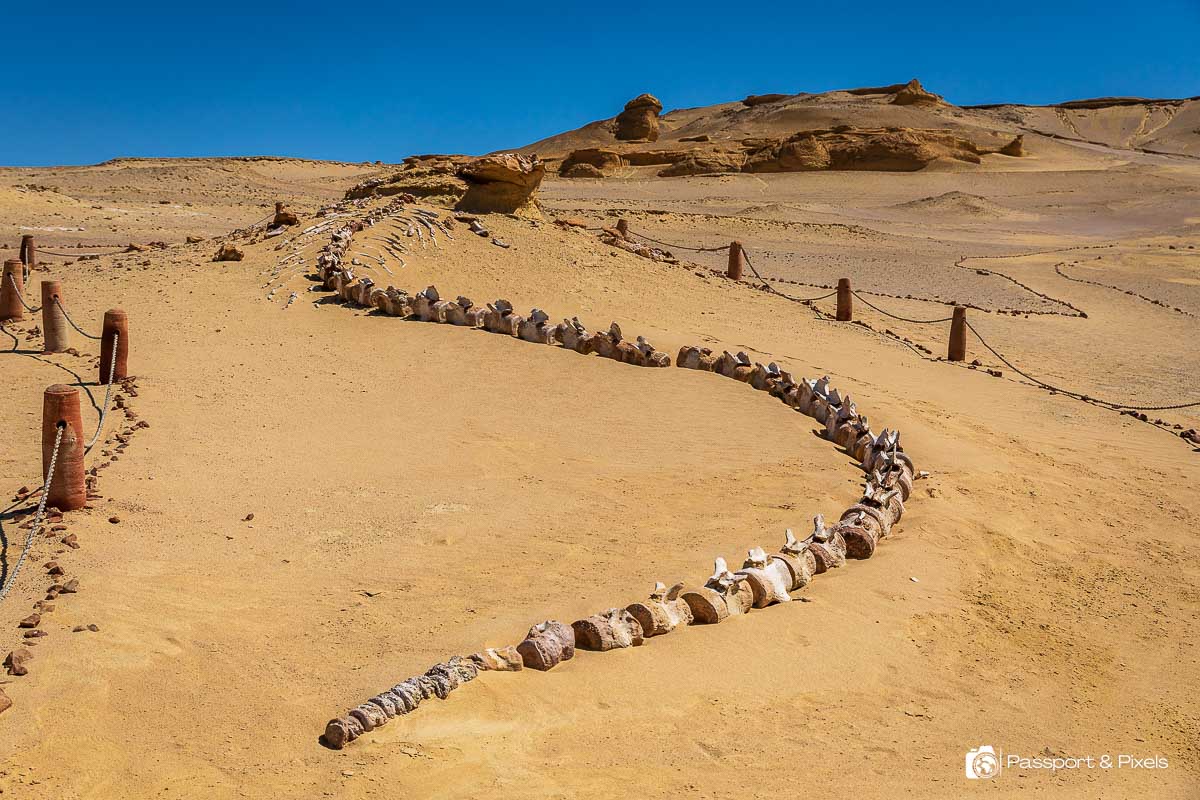
The star attractions are the Archaeoceti whales, particularly two species: Basilosaurus isis and Dorudon atrox. The largest skeleton discovered reaches up to 21 meters in length and features well-developed five-fingered flippers on the forelimbs, along with the unexpected presence of hind legs, feet, and toes. These hind limbs represent the final evolutionary stages before whales fully transitioned to marine life.
These ancient creatures had serpentine bodies and were carnivorous predators. The fossils are so well-preserved that researchers can study not only skeletal structures but also gain insights into their diet and living conditions.
More Than Just Whales
While whales are the headliners, Wadi El Hitan tells a much broader ecological story. The site contains fossils of sea cows, sharks, crocodiles, turtles, rays, bony fishes, and even bird remains, allowing scientists to reconstruct the complete ancient ecosystem. Walking through the valley, visitors encounter seashell fragments and coral scattered throughout the sand—tangible evidence of the ancient ocean that once covered this landscape.
Geological Wonders
The rocks at Wadi El Hitan comprise three main formations that reveal changing sea levels and marine environments. The Birket Qarun Formation, containing yellowish open marine sandstones, holds most of the whale fossils and forms the dramatic cliffs and buttes. Wind and water erosion have sculpted the landscape into striking geological formations, creating a visually stunning backdrop for the fossils.
Behind the site looms Garet Gehannam, known as "the Mountain of Hell." At sunset, this mountain appears to glow with an eerie red light, adding to the otherworldly atmosphere of the valley.
The Open-Air Museum Experience
Unlike traditional museums where fossils are behind glass, Wadi El Hitan offers an unparalleled open-air experience. Designated walking trails wind through the desert, with fossils displayed in their original positions—exactly where they were discovered millions of years ago. Many fossils remain partially buried in sediments, slowly revealed by natural erosion processes.
The site features several key facilities:
The Fossils and Climate Change Museum: The Middle East's first museum entirely dedicated to fossils showcases an 18-meter-long skeleton of a legged whale as its centerpiece. The museum effectively explains the geological and biological history while drawing connections to current climate issues.
Visitor Center and Facilities: Constructed with eco-mimicry principles, the architecture uses mud-brick vaults and sculptured walls designed to blend with the landscape rather than dominate it.
Marked Trails: Well-laid pathways with informative signage guide visitors through the main fossil sites, with protective shelters built over particularly significant specimens.
Desert Wildlife Today
Wadi El Hitan isn't just about ancient life. The area supports 15 species of desert plants, approximately 15 types of wild mammals including Egyptian wolves, red foxes, fennec foxes, caracals, and dorcas gazelles. Fennec foxes are the most commonly spotted mammals and regularly visit campsites at night. The nearby Wadi El Rayan lakes attract 36 species of breeding birds and 19 species of reptiles.
UNESCO World Heritage Status
In July 2005, Wadi El Hitan was designated a UNESCO World Heritage Site for its hundreds of fossils representing some of the earliest whale forms. The site earned this distinction because it demonstrates one of evolution's most iconic changes with unparalleled clarity and accessibility.
The site is state-owned with strong legal protection under Egyptian Law 102/1983 for Nature Protectorates, forbidding actions that would destroy or deteriorate the natural environment.
Planning Your Visit
Getting There
Wadi El Hitan is located within the Wadi El Rayan Protected Area. Most visitors travel from Cairo to Fayoum (approximately 2 hours), then embark on a 35-kilometer unpaved track requiring a 4x4 vehicle to reach the site. The journey through desert dunes and past the Wadi El Rayan lakes is an adventure in itself.
Entry Requirements
- Tickets must be purchased at the Wadi El Rayan Protected Area entrance
- All visits require prearranged guided tours along prescribed trails
- Foreign tourist entrance fees differ from Egyptian national rates
- Visitors must adhere to designated parking areas and pathways
Best Time to Visit
The optimal visiting period is November through April when temperatures are more comfortable. Even during cooler months, midday heat can be intense, so early morning or late afternoon visits are recommended. Summer months should be avoided due to extreme temperatures.
What to Wear and Bring
- Loose-fitting, long-sleeved shirts and long pants for sun protection
- Sturdy hiking boots for desert terrain
- Wide-brimmed hat
- Plenty of water and sunscreen
- Camera for the spectacular landscapes and fossils
Tour Options
Most visitors arrange day trips from Cairo with hotel pickup, though many prefer staying overnight in Fayoum to extend the experience. Camping under the stars near Wadi El Hitan offers an unforgettable desert experience, and some ecolodges in the area provide accommodation that supports local communities.
Activities often combined with the Valley of the Whales visit include:
- Desert safaris with dune bashing and sandboarding
- Camel and horse riding
- Visits to Tunis Village and the Magic Lake
- Felucca rides on Wadi El Rayan lakes
- Stargazing programs with astronomers
- Traditional Bedouin dinners
Conservation and Sustainable Tourism
Visitor numbers have steadily increased since implementing sustainable tourism strategies, with around 12,000 visitors recorded in 2008. However, protection of the delicate fossils remains paramount.
Strict regulations include:
- No vehicle access to the fossil sites
- Restricted visitor numbers at any given time
- Mandatory guided tours only
- Zoning that separates eco-tourism areas from research zones
The shift from unrestricted 4x4 access to controlled foot and camel treks has created employment opportunities for local communities while protecting this irreplaceable natural heritage.
The Discovery and Research
The first whale fossil skeletons were discovered in winter 1902-03, though they attracted relatively little interest for 80 years due to the area's remoteness. When 4x4 vehicles became widely available in the 1980s, renewed interest brought both researchers and, unfortunately, fossil collectors who removed specimens.
This threat prompted conservation efforts that eventually led to the site's protection and UNESCO designation. University of Michigan expeditions have been instrumental in excavation and research, including the recovery of complete 15-meter Basilosaurus isis skeletons for scientific study.
Why Wadi El Hitan Matters
Wadi El Hitan is the most important site globally to demonstrate one of the iconic changes in Earth's life record: whale evolution from land animals to marine existence. The fossils here don't just show what these transitional whales looked like—they reveal how they lived, what they ate, and the environment they inhabited.
This site bridges a critical gap in our understanding of mammalian evolution. The presence of hind limbs on these ancient whales provides tangible evidence of their terrestrial ancestry, while their streamlined bodies and flippered forelimbs show their adaptation to aquatic life.
Practical Tips
- Book tours in advance, especially during peak season (November-April)
- Consider staying overnight in Fayoum to avoid rushing
- Start early to avoid midday heat and crowds
- Allow 3-4 hours to fully explore the trails and museum
- Respect all regulations—touching or taking fossils is strictly prohibited
- Support local businesses and guides to promote sustainable tourism
- Bring cash as card facilities may be limited
Beyond the Fossils
While the ancient whales are the main attraction, the journey to Wadi El Hitan offers additional rewards. The drive through ever-changing desert landscapes, the startling sight of freshwater lakes in the midst of sand dunes, and the profound silence of the desert create an experience that transcends paleontology.
Standing where an ancient ocean once thrived, surrounded by the remains of creatures that walked the evolutionary path from land to sea, visitors gain a humbling perspective on deep time and the dynamic nature of our planet.
Final Thoughts
Wadi El Hitan represents a unique convergence of scientific importance, natural beauty, and accessibility. Few places on Earth allow you to walk among 40-million-year-old fossils in their original setting, surrounded by a landscape that itself tells a story of dramatic environmental change.
Whether you're a paleontology enthusiast, nature lover, or simply seeking an adventure off Egypt's beaten tourist path, the Valley of the Whales offers an unforgettable journey through time. It reminds us that the familiar world we inhabit is merely the latest chapter in Earth's ongoing story—and that even the mightiest ocean creatures once took their first uncertain steps on dry land.
This remarkable site deserves its place among the world's most treasured natural heritage locations, offering insights into our planet's past while inspiring wonder about the forces that continue to shape life on Earth.
