
The Lighthouse of Alexandria: Egypt's Ancient Maritime Marvel
The Lighthouse of Alexandria, known in ancient times as the Pharos of Alexandria, stands as one of the Seven Wonders of the Ancient World and represents one of Egypt's most remarkable architectural achievements. This towering beacon once guided ships safely into the bustling harbor of Alexandria for over 1,500 years, cementing Egypt's position as a center of ancient maritime trade and innovation.
History of the Lighthouse of Alexandria
Built between 280 and 247 BCE during the Ptolemaic Kingdom of Egypt, the Lighthouse of Alexandria was commissioned by Ptolemy I Soter and completed during the reign of his son, Ptolemy II Philadelphus. The architect Sostratus of Cnidus designed this magnificent structure on the small island of Pharos, which connected to Alexandria's mainland by a causeway called the Heptastadion.
The lighthouse served as both a navigational aid for Mediterranean sailors and a symbol of Alexandria's power and prosperity. Ancient Egypt's strategic location at the crossroads of Africa, Asia, and Europe made Alexandria one of the most important ports in the ancient world, and the Pharos ensured safe passage for countless vessels carrying goods, travelers, and knowledge.
Architecture and Design of the Pharos
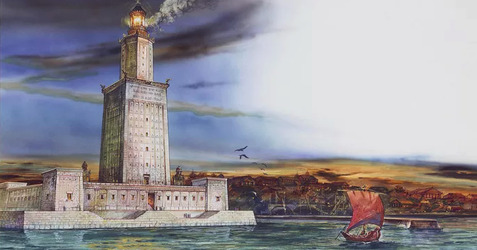
The Lighthouse of Alexandria was an engineering masterpiece that showcased ancient Egyptian innovation and Hellenistic architectural brilliance. Standing approximately 100-130 meters (330-430 feet) tall, it was one of the tallest man-made structures in the ancient world for centuries.
The Three-Tier Structure
The lighthouse featured a distinctive three-tiered design:
The Square Base: The lowest section was a massive square base approximately 30 meters per side, constructed from limestone blocks. This foundation housed approximately 300 rooms that served as workrooms and living quarters for the maintenance crew and military garrison.
The Octagonal Middle Section: Rising above the base, the middle tier featured an octagonal tower that created an elegant transition between the square base and the cylindrical top.
The Cylindrical Tower: The uppermost section was a circular colonnade that housed the beacon itself. At the very top sat a statue, possibly of Zeus, Poseidon, or Ptolemy I depicted as the sun god Helios.
The Light System
The lighthouse's beacon utilized a sophisticated fire-based system that burned continuously day and night. Ancient accounts suggest that a complex system of mirrors, possibly made of polished bronze or glass, reflected and magnified the firelight. Some historians believe the light could be seen from as far as 35 miles away, making it one of the most powerful navigational aids in the ancient Mediterranean.
The Lighthouse in Ancient Egyptian and Greek Culture
The Pharos of Alexandria became such an iconic structure that the word "pharos" entered many languages as the term for lighthouse. In modern Greek, Italian, Spanish, French, and several other languages, variations of "pharos" still mean lighthouse today.
For ancient Alexandria, Egypt's premier Hellenistic city, the lighthouse represented the fusion of Egyptian, Greek, and Mediterranean cultures. It symbolized the city's commitment to learning, trade, and cultural exchange, standing alongside the famous Library of Alexandria as a beacon of knowledge and civilization.
The Fall of the Lighthouse
Despite its robust construction, the Lighthouse of Alexandria could not withstand the forces of nature forever. A series of devastating earthquakes between the 10th and 14th centuries CE gradually damaged the structure. The most significant damage occurred during earthquakes in 956, 1303, and 1323 CE.
By 1480 CE, the lighthouse had been reduced to ruins. The Mamluk Sultan Qaitbay used some of the fallen stones to construct the Citadel of Qaitbay on the same location, which still stands today at the entrance to Alexandria's Eastern Harbor.
Archaeological Discoveries and Modern Research
Recent decades have brought exciting archaeological discoveries related to the Lighthouse of Alexandria. In 1994, French archaeologist Jean-Yves Empereur led underwater expeditions that discovered massive stone blocks, statues, and architectural elements believed to be from the ancient lighthouse scattered on the seafloor near Qaitbay's Citadel.
These underwater archaeological sites have provided invaluable insights into the lighthouse's construction and appearance. Divers have recovered sphinxes, columns, and other architectural fragments that help historians better understand this ancient Egyptian wonder.
Visiting the Lighthouse Site in Alexandria, Egypt
Today, visitors to Alexandria can explore the site where the Lighthouse of Alexandria once stood. The Citadel of Qaitbay, built with stones from the fallen lighthouse, offers stunning views of the Mediterranean Sea and Alexandria's harbor.
How to Visit:
Location: The citadel is located at the entrance to the Eastern Harbor in Alexandria, approximately 220 kilometers north of Cairo.
Getting There: Alexandria is easily accessible from Cairo by train, bus, or car. The journey takes about 2-3 hours. Once in Alexandria, taxis and ride-sharing services can take you directly to the Qaitbay Citadel.
Opening Hours: The site is generally open daily, but hours may vary seasonally.
Nearby Attractions: Visitors should also explore the Bibliotheca Alexandrina (the modern Library of Alexandria), the Alexandria National Museum, and the Catacombs of Kom el Shoqafa.
The Lighthouse's Legacy in Egyptian Tourism
The Lighthouse of Alexandria remains a powerful draw for tourists visiting Egypt. While the physical structure no longer exists, its legacy lives on through:
- The Citadel of Qaitbay, built on its foundation
- Underwater archaeological sites open for diving expeditions
- Representations in museums across Egypt and the world
- Its enduring status as one of the Seven Wonders of the Ancient World
Egypt's Ministry of Tourism and Antiquities has long discussed plans for creating better visualization and interpretation of the lighthouse site, potentially including digital reconstructions and enhanced museum exhibits.
The Seven Wonders of the Ancient World
The Lighthouse of Alexandria holds a special place among the Seven Wonders of the Ancient World. Of these seven magnificent structures, only the Great Pyramid of Giza, also located in Egypt, survives relatively intact today. This makes Egypt the home to two of the ancient world's most celebrated monuments.
The seven wonders were:
- The Great Pyramid of Giza (Egypt)
- The Hanging Gardens of Babylon
- The Statue of Zeus at Olympia
- The Temple of Artemis at Ephesus
- The Mausoleum at Halicarnassus
- The Colossus of Rhodes
- The Lighthouse of Alexandria (Egypt)
Conclusion: Remembering Egypt's Maritime Wonder
The Lighthouse of Alexandria represents ancient Egypt's ingenuity, ambition, and central role in Mediterranean civilization. Though earthquakes have reduced this magnificent structure to ruins, its legacy endures in archaeological discoveries, historical records, and the collective memory of humanity.
For travelers planning to visit Egypt, Alexandria offers a unique blend of ancient history and coastal Mediterranean charm. Walking along the corniche, visiting the Citadel of Qaitbay, and imagining the ancient Pharos standing tall against the sea provides a profound connection to Egypt's rich Hellenistic heritage.
The lighthouse reminds us that Egypt's wonders extend beyond the pyramids and pharaohs of the ancient dynasties. The Ptolemaic period brought its own magnificent achievements, and the Lighthouse of Alexandria stands as a testament to the timeless human drive to build, explore, and illuminate the darkness.
Whether you're a history enthusiast, an archaeology buff, or simply someone drawn to Egypt's incredible ancient monuments, the story of the Lighthouse of Alexandria continues to inspire wonder more than two millennia after its construction.
Plan Your Visit to Alexandria, Egypt: Discover where the Lighthouse of Alexandria once stood and explore the rich history of Egypt's Mediterranean jewel. Contact local tour operators or visit Egypt's official tourism website for current travel information and guided tours of Alexandria's ancient sites.
