
The Heliopolitan Creation Myth: Ancient Egypt's Story of Origins
The Heliopolitan creation myth stands as one of ancient Egypt's most influential narratives about how the world began. Originating from Heliopolis, the "City of the Sun," this Egyptian creation myth offers a profound glimpse into how the ancient Egyptians understood the cosmos, divine power, and the origins of existence itself.
The Primordial Waters and the Birth of Atum
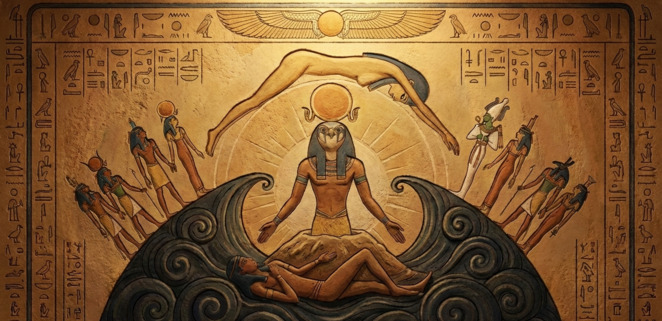
At the heart of the Heliopolitan creation myth lies Egyptian Atum, the self-created deity who emerged from the primordial waters of Nun. Unlike other gods who required parents or creators, Atum brought himself into existence through sheer force of will—a concept that fascinated ancient Egyptian theologians and philosophers.
In the beginning, according to this Egyptian creation myth, there was only Nun, the infinite ocean of chaos and nothingness. From these dark, formless waters, Atum rose upon the primeval mound, the first solid ground to exist in the universe. This benben stone, as it was called, became the sacred prototype for later Egyptian pyramids and obelisks.
The Ennead: Atum's Divine Family
Egyptian Atum didn't remain alone for long. Through acts of self-generation, he created the first divine pair: Shu, the god of air, and Tefnut, the goddess of moisture. Different versions of the Heliopolitan creation myth describe this creative act variously—some texts suggest Atum sneezed or spat out these deities, while others describe more mystical processes of emanation.
From Shu and Tefnut came Geb, the earth god, and Nut, the sky goddess. These two deities were locked in an eternal embrace until their father Shu separated them, creating the space between earth and sky where life could flourish. This dramatic separation became a defining moment in the Egyptian creation myth, establishing the fundamental structure of the cosmos.
The next generation brought forth the most famous deities in Egyptian mythology: Osiris, Isis, Seth, and Nephthys. Together with Atum and their ancestors, these nine gods formed the Great Ennead of Heliopolis, the divine council that governed the cosmos.
The Role of Ra and Solar Theology
As the Heliopolitan creation myth evolved, Egyptian Atum became increasingly associated with Ra, the sun god. In many texts, the two merged into Atum-Ra, embodying both the creative force of the beginning and the life-giving power of the sun. This fusion reflected the central importance of solar worship in ancient Egyptian religion.
Each day, Ra's journey across the sky reenacted the original creation, bringing light and order from darkness and chaos. Each night, his voyage through the underworld represented a return to the primordial state before renewal at dawn. This cyclical understanding of creation permeated Egyptian thought about time, death, and rebirth.
Ptah and Alternative Creation Traditions
While the Heliopolitan creation myth dominated much of Egyptian theology, other cities developed their own creation narratives. Most notably, Memphis promoted Ptah Egyptian god as the supreme creator. According to the Memphite theology, Ptah created the world through thought and speech—conceiving the cosmos in his heart and bringing it into being through the power of his words.
This intellectual approach to creation contrasted with the more physical processes described in the Heliopolitan tradition. Ptah Egyptian god created Egyptian Atum himself, along with the other gods, making Ptah the creator of the creator in Memphis theology. Rather than competing, these different Egyptian creation myths coexisted, each offering complementary insights into the mystery of origins.
Theological Significance and Symbolism
The Heliopolitan creation myth wasn't merely an ancient story—it contained profound theological concepts that influenced Egyptian religion for millennia. The progression from one to many, from chaos to order, from formlessness to structure represented fundamental principles of Egyptian cosmology.
The image of Egyptian Atum as self-created emphasized the concept of divine autogenesis, the ability to bring oneself into existence without external cause. This made Atum a symbol of ultimate creative power and independence, qualities that pharaohs sought to embody in their own reigns.
The benben stone where Atum first stood became one of Egypt's most sacred symbols. Temples housed representations of this primeval mound, and pyramid capstones called benbenets commemorated this moment of first creation. Even the shape of obelisks echoed this symbolism, their pointed tops catching the first and last rays of the sun.
Ritual and Religious Practice
The Heliopolitan creation myth deeply influenced Egyptian religious practice. Temple rituals often reenacted elements of creation, with priests symbolically maintaining cosmic order through daily ceremonies. The morning opening of temple sanctuaries represented the first sunrise, while evening closings returned the god to the primordial state of potentiality.
Funerary texts frequently invoked Egyptian Atum and the creation narrative, seeking to connect the deceased with the eternal cycles of creation and rebirth. By identifying with Atum or Ra, the dead hoped to participate in the same regenerative powers that brought the world into being.
Legacy and Modern Understanding
Today, the Heliopolitan creation myth continues to fascinate scholars and spiritual seekers alike. It represents one of humanity's earliest attempts to explain existence through symbolic narrative, addressing questions that remain profound: Why is there something rather than nothing? How did order emerge from chaos? What is humanity's place in the cosmos?
The Egyptian creation myth from Heliopolis influenced later religious traditions throughout the Mediterranean world. Its concepts of a self-created deity, a primordial ocean of chaos, and creation through divine speech found echoes in other ancient Near Eastern cosmologies.
Modern Egyptologists continue to discover new texts and interpretations of this ancient narrative. Each temple, each papyrus, each carved relief adds nuance to our understanding of how the ancient Egyptians conceived their world's origins. The relationship between Egyptian Atum and Ptah Egyptian god, the symbolism of the Ennead, and the solar theology of Ra all remain active areas of scholarly investigation.
Conclusion
The Heliopolitan creation myth offers far more than an ancient story about gods and cosmic events. It represents a sophisticated theological system that grappled with existence's deepest mysteries. Through the figure of Egyptian Atum rising from the waters of Nun, through the separation of earth and sky, through the birth of the great gods, this Egyptian creation myth provided a framework for understanding reality itself.
Whether compared with the intellectual theology of Ptah Egyptian god or examined on its own terms, the Heliopolitan tradition reveals the remarkable depth of ancient Egyptian religious thought. These ancient narratives continue to speak across millennia, reminding us that the questions of origin, purpose, and meaning have always been central to the human experience.
home
