
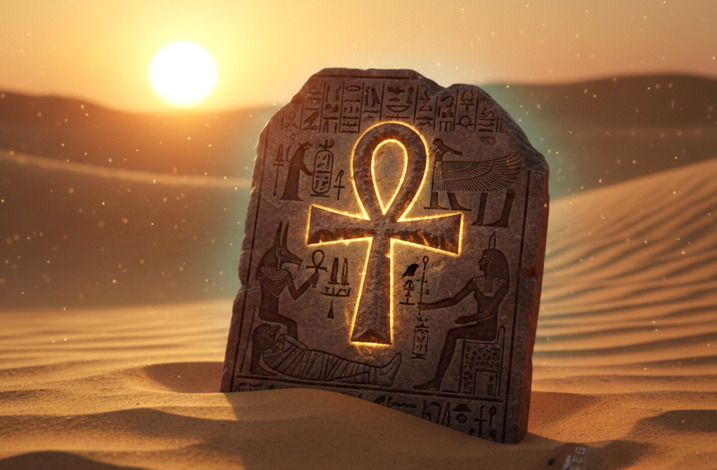
Ankh Symbol of Life: Meaning, Origins & Egyptian Beliefs
The ankh symbol of life stands as one of humanity's most enduring and recognizable emblems from ancient Egypt. This distinctive cross with a loop at the top has transcended millennia, carrying profound spiritual significance that continues to captivate people worldwide. Understanding the ankh meaning opens a window into ancient Egyptian spirituality and reveals why this symbol remains so powerful today.
What Is the Ankh Symbol?
The ankh, also known as the ankh key of life, resembles a cross with an oval loop replacing the upper arm. Ancient Egyptians called it "ankh," which directly translates to "life" or "breath of life." This simple yet profound design became the hieroglyphic character representing eternal life, making it one of the most important symbols in Egyptian iconography.
The ankh symbol of life appears throughout Egyptian art, from temple walls to tomb paintings, often held by gods and pharaohs. Its prevalence across three thousand years of Egyptian civilization demonstrates its fundamental importance to their worldview.
The Deep Ankh Meaning in Ancient Egyptian Culture
The ankh meaning extends far beyond a simple representation of life. To ancient Egyptians, it embodied:
Eternal Life and Immortality
The ankh primarily symbolized eternal life, not just physical existence but the everlasting spiritual life promised to the righteous after death. Gods frequently hold the ankh to the nose of deceased pharaohs in tomb art, symbolically breathing eternal life into them for the afterlife journey.
Divine Power and Authority
The ankh key of life served as a symbol of divine authority. Only deities and royalty were typically depicted holding the ankh, emphasizing their connection to divine power and their role as intermediaries between the mortal and divine realms.
Union of Opposites
Many scholars interpret the ankh's shape as representing the union of male and female principles—the vertical line symbolizing the masculine and the loop representing the feminine. This union creates and sustains all life, embodying the fundamental creative force of the universe.
The Gift of Life
Gods are often shown extending the ankh toward pharaohs or placing it near their lips, representing the divine gift of life and breath. This imagery reinforced the belief that life itself was a sacred gift from the gods.
Historical Origins of the Ankh Key of Life
While the exact origins of the ankh symbol of life remain debated among Egyptologists, several theories exist:
The Sandal Strap Theory: Some scholars suggest the ankh evolved from a stylized sandal strap viewed from above, with the loop representing where the foot would enter.
The Tjet (Isis Knot) Connection: Others propose connections to the tjet, another Egyptian symbol associated with the goddess Isis and protection.
The Sun on the Horizon: Another interpretation views the ankh as representing the sun rising over the horizon, with the loop being the sun and the cross representing the horizon and earth.
Despite uncertain origins, the ankh meaning crystallized early in Egyptian history, appearing in artifacts from the Early Dynastic Period (around 3150 BCE) and continuing through the Coptic Christian era.
The Ankh in Egyptian Religion and Daily Life
In Religious Ceremonies
The ankh key of life played a central role in religious rituals. Priests used ankh-shaped ritual objects during ceremonies, and the symbol appeared on temple offerings and sacred texts. It represented the eternal life promised by the gods to those who lived according to Ma'at (divine order and truth).
Royal Symbolism
Pharaohs incorporated the ankh into their regalia, reinforcing their divine status as living gods. The ankh symbol of life appeared on crowns, scepters, and thrones, constantly reminding subjects of the pharaoh's connection to immortality and divine power.
Funerary Practices
Perhaps nowhere was the ankh meaning more significant than in death and burial customs. Ankhs were:
- Placed in tombs as protective amulets
- Painted on coffins and sarcophagi
- Included in the Book of the Dead illustrations
- Worn as amulets by the deceased for protection in the afterlife
Everyday Amulets
Common Egyptians wore ankh amulets for protection and blessings. These talismans were believed to attract health, prosperity, and divine favor during life, while ensuring safe passage to the afterlife upon death.
Gods and Goddesses Associated with the Ankh
Nearly all Egyptian deities are depicted holding the ankh key of life, but certain gods have particularly strong associations:
Isis: The great mother goddess frequently appears holding the ankh, emphasizing her role as a life-giver and protector.
Osiris: As the god of the afterlife and resurrection, Osiris holds the ankh to represent his dominion over eternal life.
Anubis: The jackal-headed god of mummification and the afterlife uses the ankh in funerary rites.
Ra: The sun god carries the ankh as a symbol of the life-giving power of the sun.
The Ankh Symbol in Modern Times
The ankh symbol of life has experienced a remarkable revival in contemporary culture:
Spiritual and Religious Use
Modern spiritual practitioners, especially those interested in Egyptian spirituality and Kemeticism (the revival of ancient Egyptian religion), use the ankh in meditation and ritual. Its representation of eternal life resonates with various New Age and spiritual movements.
Fashion and Jewelry
The distinctive shape of the ankh key of life makes it a popular jewelry choice. People wear ankh necklaces, rings, and earrings as symbols of life affirmation, spiritual connection, or appreciation of ancient wisdom.
Popular Culture
The ankh appears in movies, video games, literature, and art, often representing mystery, ancient wisdom, or supernatural power. Its iconic shape makes it instantly recognizable across cultures.
Tattoo Symbolism
Many people choose the ankh symbol of life for tattoos, drawn to its meanings of eternal life, spiritual awakening, and connection to ancient wisdom. The design's elegance and deep symbolism make it a timeless choice.
Interpreting the Ankh Meaning Today
While we may not worship the Egyptian pantheon, the ankh meaning still offers valuable insights:
Affirmation of Life: The ankh reminds us to cherish life as sacred and precious.
Balance and Harmony: Its representation of united opposites encourages us to seek balance in our lives.
Spiritual Connection: The symbol invites contemplation of life beyond the physical, encouraging spiritual growth.
Protection and Blessing: Many still view the ankh as a protective symbol that attracts positive energy.
How to Incorporate the Ankh Key of Life into Your Life
If you're drawn to the ankh symbol of life, consider these meaningful ways to connect with it:
- Wear it as jewelry: Choose a quality ankh pendant or ring as a daily reminder of life's sacredness
- Use it in meditation: Visualize the ankh during meditation to connect with ancient wisdom
- Display it in your home: Place ankh artwork or sculptures in spaces where you seek peace and reflection
- Study its history: Deepen your understanding by learning more about ancient Egyptian culture
- Create art: Incorporate the ankh into your creative expressions
The Enduring Legacy of the Ankh
The ankh symbol of life has survived over five thousand years not through accident but because of its profound and universal message. While it originated in the temples and tombs of ancient Egypt, its symbolism speaks to fundamental human concerns that transcend time and culture: our desire for life, our quest for meaning, and our hope for something beyond physical existence.
Understanding the ankh meaning connects us to one of humanity's oldest continuous spiritual traditions. Whether you view it as a historical artifact, a spiritual symbol, or simply beautiful iconography, the ankh key of life continues to inspire and intrigue, proving that some symbols truly are timeless.
The ankh reminds us that the ancient Egyptians understood something profound about existence—that life is sacred, death is not an ending but a transformation, and the human spirit reaches toward eternity. In our modern world, sometimes disconnected from ancient wisdom, the ankh offers a tangible link to timeless truths about the preciousness of life and the eternal nature of the soul.
