
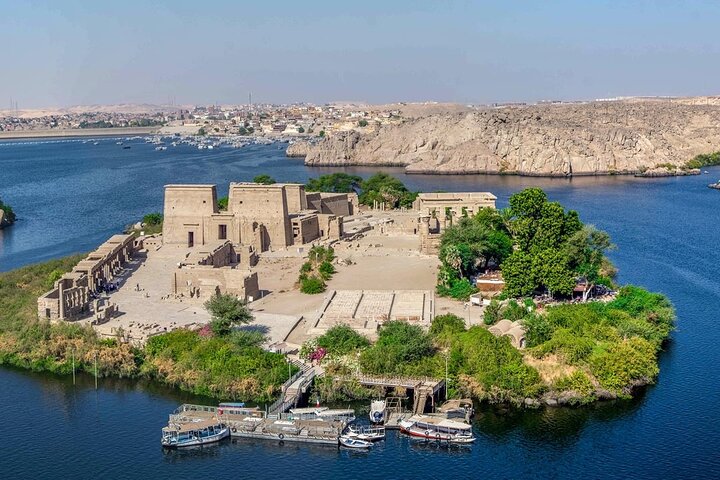
Philae Temple Relocation: The Incredible Rescue of Egypt’s Sacred Island
The Philae Temple relocation is one of the greatest archaeological rescue missions in history. When the waters of the Nile began to threaten the ancient sanctuary, an international effort saved this magnificent temple complex from disappearing forever. Today, visitors can still admire the beauty of Philae Temple, thanks to an extraordinary engineering project that moved the entire site stone by stone.
Located near Aswan, the temple is dedicated mainly to the goddess Isis, and it remains one of the most fascinating examples of ancient Egyptian architecture and modern preservation.
The Historical Importance of Philae Temple
For centuries, Philae Temple was one of the most important religious centers in ancient Egypt. The temple complex was originally built on Philae Island.
Construction began during the reign of Ptolemy II Philadelphus in the 3rd century BCE and continued under later Ptolemaic and Roman rulers. Pilgrims traveled from across Egypt and Nubia to worship Isis, who was believed to possess powerful magical abilities.
The temple complex includes:
-
The Temple of Isis
-
The Gate of Emperor Hadrian
-
The Kiosk of Trajan
-
Several chapels and colonnades
Because of its religious importance, Philae remained active even after the spread of Christianity in Egypt.
The Threat from the Aswan High Dam
The survival of Philae Temple was seriously threatened in the 20th century.
After the construction of the Aswan High Dam, rising waters of the Nile formed Lake Nasser. This massive reservoir flooded many ancient sites in southern Egypt.
Even before the High Dam, the earlier Aswan Low Dam had already caused seasonal flooding around the temple. For decades, the temple stood partially underwater for several months each year.
By the 1960s, archaeologists feared the temple would be permanently submerged.
UNESCO’s International Rescue Campaign
To save these priceless monuments, UNESCO launched a global campaign in 1960 to protect the ancient heritage of Nubia.
This project is known as the International Campaign to Save the Monuments of Nubia.
Many countries contributed expertise, funding, and technology. The same campaign also saved other famous monuments, including Abu Simbel Temples.
The relocation of Philae Temple became one of the most complex engineering achievements of the campaign.
How the Philae Temple Relocation Happened
Between 1972 and 1980, engineers carefully dismantled the entire temple complex and moved it to a new island.
First, workers built a protective dam around the original site on Philae Island and pumped the water out. Once the temple structures were dry, specialists began the delicate process of cutting the temple into manageable blocks.
Key facts about the relocation:
-
More than 40,000 stone blocks were removed
-
Each block weighed 2 to 25 tons
-
Every piece was numbered and documented
-
The stones were transported to Agilkia Island
-
The temple was reconstructed exactly as it originally stood
The new island was reshaped to resemble the original Philae Island, ensuring the temple preserved its historical appearance.
The New Home of Philae Temple
Today, Philae Temple stands beautifully on Agilkia Island.
Visitors reach the temple by boat from the marina near Philae Port. The journey across the Nile adds to the magical atmosphere of the site.
The temple complex still features:
-
Massive pylons decorated with ancient carvings
-
Elegant colonnades
-
Sacred chambers dedicated to Isis
-
Detailed reliefs showing ancient rituals
At night, tourists can enjoy the famous Sound and Light Show, which tells the story of the temple and its rescue.
Why the Philae Temple Relocation Is Important
The Philae Temple relocation is considered one of the greatest achievements in cultural preservation.
This project demonstrated that international cooperation could save endangered world heritage sites. Without this rescue effort, one of Egypt’s most beautiful temples would have been lost beneath the waters of Lake Nasser.
The project also helped inspire future global heritage protection programs.
Today, the temple stands not only as a monument to ancient Egyptian religion but also as a symbol of modern archaeological preservation.
FAQ About Philae Temple Relocation
Why was Philae Temple relocated?
Philae Temple was relocated to protect it from flooding caused by the construction of the Aswan High Dam, which created Lake Nasser and threatened to submerge the temple permanently.
Where was Philae Temple moved?
The temple was moved from Philae Island to Agilkia Island, located a short distance away in the Nile near Aswan.
When was the relocation completed?
The relocation project took place between 1972 and 1980 as part of UNESCO’s international campaign to save Nubian monuments.
How was Philae Temple moved?
Engineers carefully dismantled the temple into more than 40,000 stone blocks, transported them to Agilkia Island, and reconstructed the temple exactly as it originally stood.
Can tourists visit Philae Temple today?
Yes. Philae Temple is one of the most popular attractions in Aswan and can be reached by boat. Visitors can explore the temple complex and attend the Sound and Light Show.
