
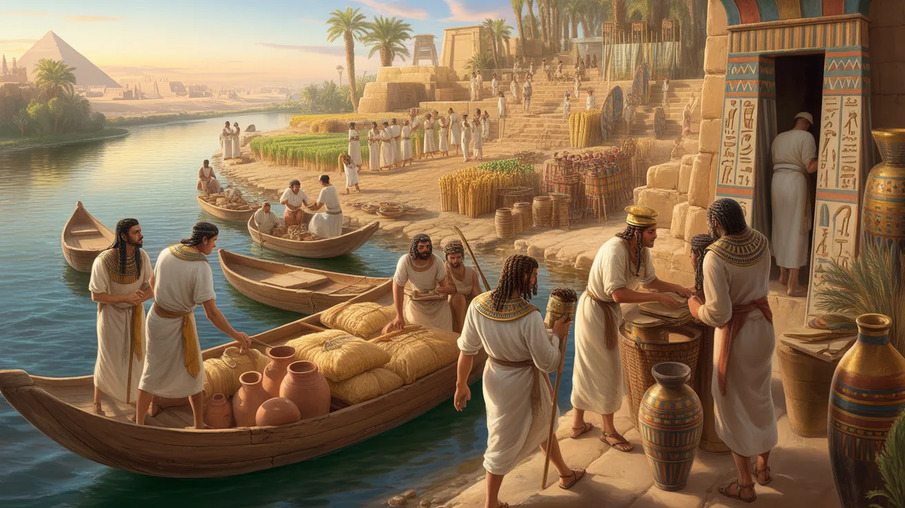
Economy of Ancient Egypt: Trade, Society, and Wealth Along the Nile
The economy of ancient Egypt was one of the most stable and sophisticated economic systems in the ancient world. Sustained by the Nile River, organized labor, and far-reaching trade networks, Egypt’s economy supported monumental architecture, a complex social hierarchy, and a civilization that lasted for thousands of years.
In this guide, we explore how the ancient Egyptian economy worked, how trade shaped its power, and how social structure and geography influenced prosperity.
Where Is Ancient Egypt Located?
To understand the economy of ancient Egypt, we must first ask: where is ancient Egypt located?
Ancient Egypt was located in Northeast Africa, stretching along the fertile banks of the Nile River, from the Mediterranean Sea in the north to the First Cataract near modern-day Aswan in the south. Surrounded by deserts on both sides, Egypt’s location offered natural protection while the Nile provided water, fertile soil, and transportation routes—making economic growth possible.
Ancient Egypt Time Period and Historical Context
The ancient Egypt time period spans over 3,000 years, making it one of the longest-lasting civilizations in history. According to the Egypt ancient history timeline, historians divide this era into major periods:
-
Early Dynastic Period (c. 3100–2686 BCE)
-
Old Kingdom (c. 2686–2181 BCE)
-
Middle Kingdom (c. 2055–1650 BCE)
-
New Kingdom (c. 1550–1070 BCE)
-
Late Period (c. 664–332 BCE)
Each period contributed to economic development through agriculture, administration, and ancient Egypt trade.
Agriculture: The Foundation of the Economy of Ancient Egypt
Agriculture was the backbone of the economy of ancient Egypt. The annual flooding of the Nile deposited rich silt onto farmland, allowing farmers to grow crops such as:
-
Wheat and barley
-
Flax (used for linen)
-
Vegetables, dates, and legumes
The state controlled land distribution, crop storage, and surplus collection. Farmers paid taxes in grain, which was stored in state granaries and redistributed to workers, priests, and officials.
Ancient Egypt Trade: Local and International Exchange
Ancient Egypt trade played a crucial role in expanding wealth and influence. While Egypt was rich in agricultural products, it lacked certain natural resources, such as timber and precious metals.
Major Trade Goods
-
Exports: grain, linen, papyrus, gold, beer
-
Imports: cedar wood (Lebanon), incense (Punt), silver (Anatolia), lapis lazuli (Afghanistan)
Trade routes connected Egypt with Nubia, the Levant, Punt, and Mesopotamia. The Nile River served as the main trade highway, while Red Sea ports enabled maritime trade.
Currency and Labor System
Early in the economy of ancient Egypt, there was no coinage. Instead, Egyptians used a barter system and a unit of value called the deben, based on weight (usually copper or silver).
Workers—especially those who built temples and pyramids—were not slaves in most cases. They were paid in:
-
Grain
-
Beer
-
Clothing
-
Housing
This organized labor system was essential to Egypt’s long-term economic stability.
Ancient Egypt Social Structure and Economic Roles
The ancient Egypt social structure was deeply connected to economic function. Society was hierarchical, and each class played a specific role in sustaining the economy:
-
Pharaoh – supreme ruler and controller of land and resources
-
Nobles & Priests – managed estates, temples, and trade
-
Scribes & Officials – recorded taxes, trade, and production
-
Artisans & Merchants – produced goods and facilitated trade
-
Farmers – formed the economic backbone
-
Laborers & Servants – supported construction and daily life
This structured system ensured efficient resource management across the kingdom.
Government Control and Economic Planning
The Egyptian state tightly controlled economic activity. Officials measured flood levels, predicted harvests, collected taxes, and redistributed resources. Temples also functioned as economic centers, owning land, employing workers, and storing wealth.
This centralized control helped Egypt survive droughts, invasions, and political changes across the Egypt ancient history timeline.
Why the Economy of Ancient Egypt Was So Successful
Several factors explain the long-lasting success of the economy of ancient Egypt:
-
Predictable Nile flooding
-
Strategic geographic location
-
Advanced administration and record-keeping
-
Strong trade networks
-
Stable social structure
Together, these elements created one of the most resilient economies of the ancient world.
Conclusion
The economy of ancient Egypt was far more than farming—it was a complex system shaped by geography, trade, government control, and social hierarchy. From the Nile’s fertile banks to international trade routes, Egypt built a sustainable economic model that supported its civilization for millennia.
Understanding this economy provides valuable insight into how ancient societies thrived and why Egypt remains a cornerstone of world history.
